

At 9:00 the buyer of unit 12.05, a hypothetical apartment, is handed a pen. The handover engineer already has a form with a signature block. In bedroom 2 the paint on the door reveal has blistered across a palm-sized patch. The balcony door has no handle, and the handover schedule says the handle comes with the door set.
An apartment handover checklist is the sheet you fill in while you walk the unit. It compares what is installed with the contract, the handover schedule and the drawing you may use that morning, and it records what is missing or wrong before anyone signs. The point of this article is that a signature goes on the page in front of you, and that page says nothing yet about the blister or the missing handle. So each thing you saw should become a line on the form before a pen moves.
The contract and the developer's form decide who may refuse to sign, which items must be finished before the keys change hands and what the signature binds you to; this article has no source for those points. What follows is for a buyer or the engineer leading the visit, and it does not replace the contract.
Why walking and signing are different jobs
Both happen in one appointment, so people merge them. Walking is looking, trying and writing. Signing is accepting a document. You can finish the walk with ten lines and still not sign, because those lines are not on the form. You can also sign a form that lists every open line with a date beside it.
In unit 12.05 the engineer suggests signing first and noting the paint later. The buyer asks where the missing balcony handle will appear on the form, since the schedule says it should be there. The engineer offers to take a photo. The buyer points out that the photo sits on one person's phone, while the form is what both sides carry away, so it needs a line: which room, what is missing, who fixes it, by when. A photo helps you remember. A line on the form is what both sides hold.
Three steps for the handover walk
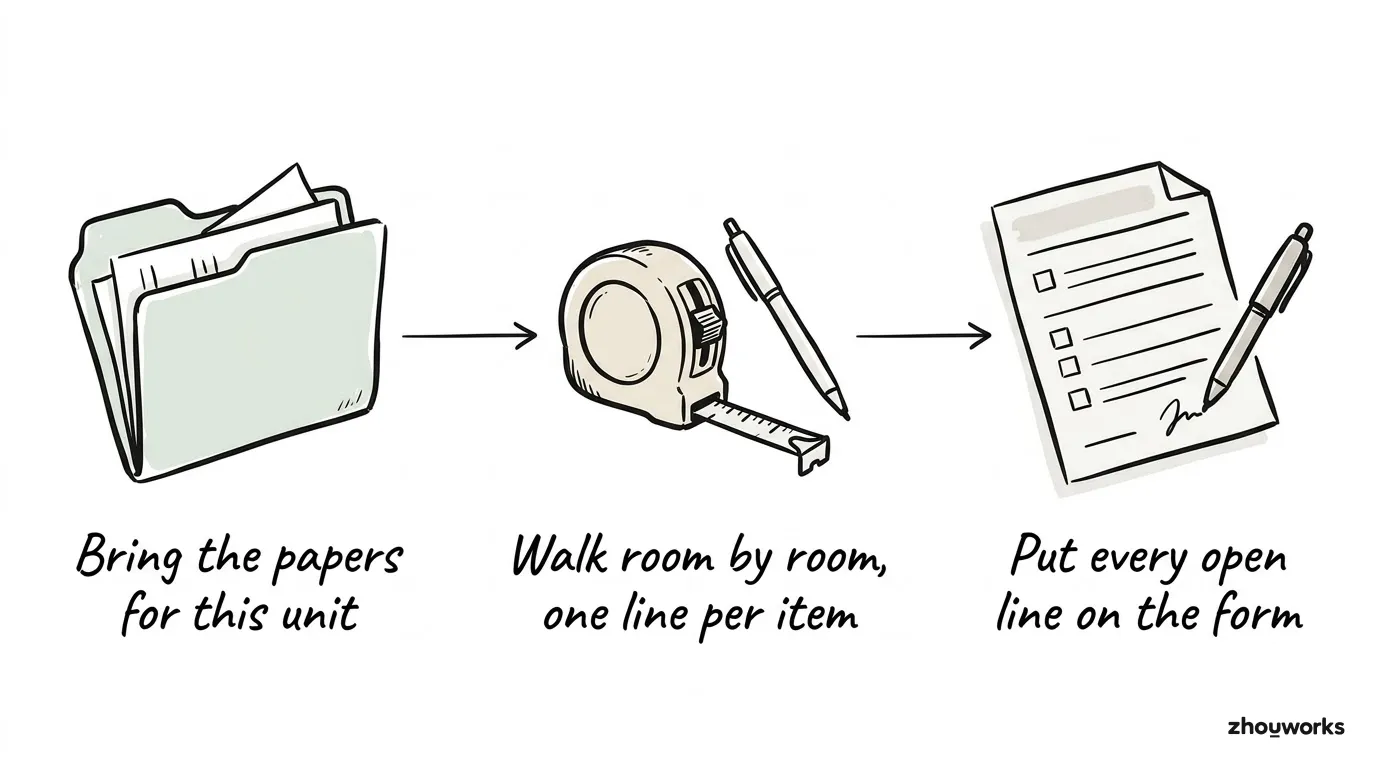
Step 1: bring the papers for this unit. That means the contract, the schedule naming the doors, finishes and appliances handed over, and the drawing issued for this visit if there is one. A file dropped in a group chat after the issued set is not automatically the set you check against. Add a tape, a pen, paper or a tablet, and a phone with enough battery for photos. A second person helps: one listens to the engineer while the other writes. The engineer leading the visit prepares a form with room for items that are off, not only a place to sign.
Step 2: walk room by room, one line per item. Walk in one direction. A usable order is entry, living room, kitchen, balcony, each bedroom, each bathroom, then the unit's electrical board if the contract lets you open it. Each line has five parts: place, what you see, work required, who takes it, date. For unit 12.05 the two lines look like this; the dates are assumed.
| Item | Place | What you see | Work required | Who takes it | Date |
|---|---|---|---|---|---|
| Balcony handle | Living-room balcony door | Not fitted | Fit the type named in the schedule | Door crew | 14 days after the visit |
| Paint | Bedroom 2, hinge side of the reveal | Blister about the size of a palm | Scrape and repaint to the finish being handed over | Finishes crew | 7 days after the visit |
"Bad paint" cannot send a crew anywhere. "Bedroom 2, hinge side of the reveal, blister the size of a palm" can be found by someone who has not been in the unit. A photo tied to its line lets someone who was not there see the blister; a photo with no line is just an album of an apartment.
Step 3: put every open line on the form, then sign. The list of work still missing or still off the documents you may use is what site teams call a punch list. On a handover visit it belongs on the form or on a sheet attached to it, not only in photos. A line that says "will fix later" with no place means nobody knows next week which room to enter. The recipient keeps one copy. The engineer keeps a copy with the same lines, not a clean copy with the defects removed. If the two copies differ, the visit is not finished.
A line closes when the person named on it looks again at the unit and accepts the work. Deleting a photo, or a message saying "done", does not close it.
How do you leave? Write one of three outcomes on the form. The parts you inspected match and both sides sign for that scope. Lines remain open, each line and date is on the form, and you sign, if your contract allows signing that way. Or nobody signs yet, because open lines are not on the form or because the missing supply left most tests undone.
What to look at in each room
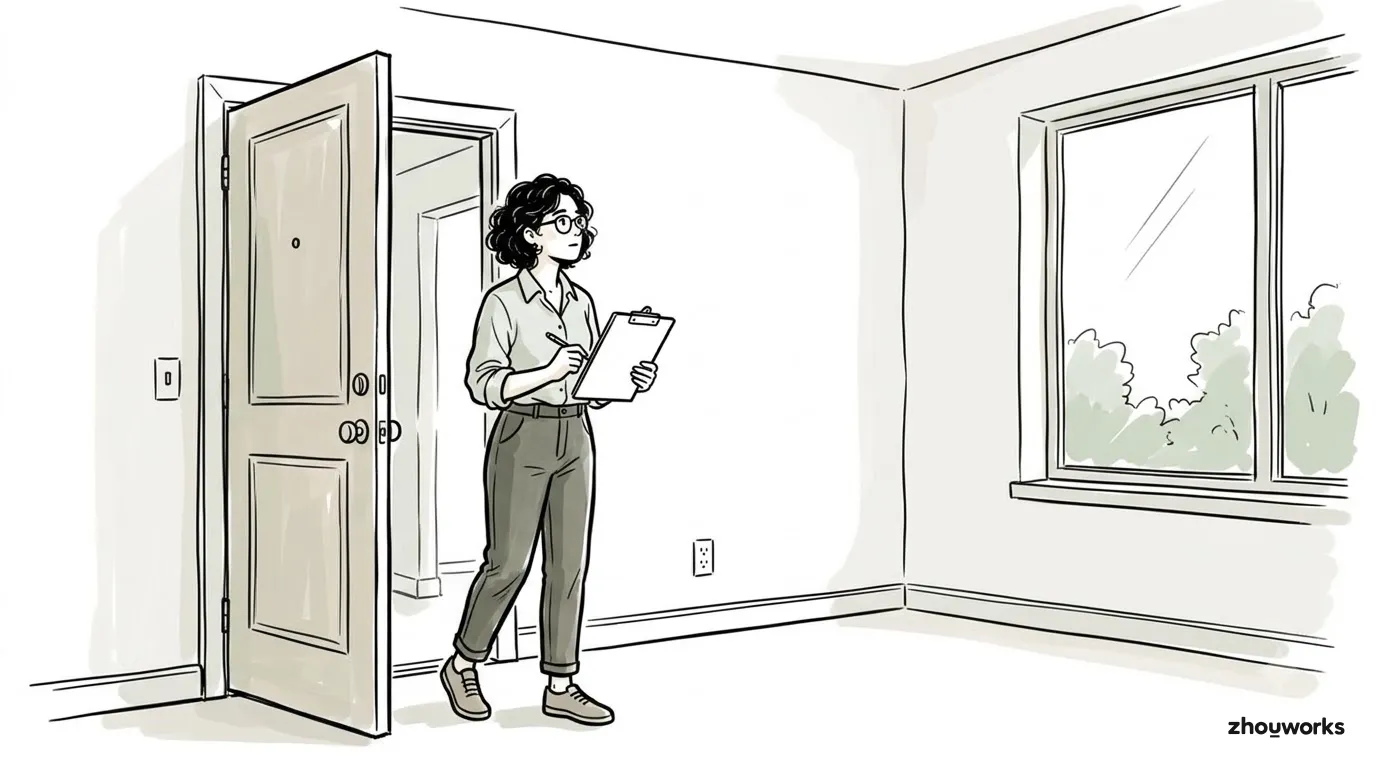
Walk the rooms while you are still inside. Open lines come before the signature.
In every room ask three things: is this item in the schedule, does it work, and where does it differ from the drawing in use.
Doors, floors, walls, ceilings. Open and close each leaf, listen to the hinges, look for light at the gap. A blister, a hairline crack, a misaligned tile joint or a stained ceiling needs a place another person can stand in. Skirting and floor edges sit low, so crouch for one lap.
Power. Switch on every light and try every socket. If a lamp stays dark, write the room and the switch; do not decide yet whether the lamp or the circuit failed. If you can see the breakers, write which one will not stay on, and leave the board closed. When the schedule gives a count of sockets or lights, count them: a missing point is a different line from a point that is installed and dead.
Water and sanitary fittings. Open taps, flush, look at traps and the basin edge. A stain on the ceiling matters more than a tap that runs weakly for ten seconds. Run the water heater when the schedule includes it and power is on.
Balcony and windows. Handle, lock, track, gap at the sill. Give the railing a light push and look at visible fixings. Do not climb or remove anything. For glass, one person stays inside while another looks for cracks from a safe edge. A cracked corner and construction dirt are two lines.
Schedule items. Hob, hood, sink, tap, heater, air conditioner, whichever the contract says are handed over. Missing entirely is "not installed." Installed but chipped, crooked or dead is another line.
The sheet to copy
Copy this block onto paper or into a note. Empty lines are for the real visit.
Unit: … Date, time in, time out: … Buyer or recipient: … Person leading the visit, and their company: … Contract and schedule being checked: … Drawing allowed for this visit (number and issue): …
☐ Entry door: lock, gap, hinges ☐ Living room walls, ceiling, floor ☐ Kitchen: items named in the schedule; run them if power and water are on ☐ Schedule items: hob, hood, sink, tap, heater, anything else listed, name and count ☐ Balcony: handle, lock, railing, glass ☐ Each bedroom: door, paint, floor, window ☐ Each bathroom: drain, basin, flush, taps ☐ Power: switches, sockets, lights, the unit's board ☐ Items you could not test, and why ☐ Each open line has a place, the work required, a name and a date ☐ Those lines are on the form before anyone signs
Strike a box that does not apply and write why, for example "no balcony." A blank box looks like a room nobody entered.
When the walk does not run straight
These cases change what you write, not the order of the three steps.
No power or water. Write "not tested, no supply," not "pass." If most items could not be tested, you may want to hold off signing and ask the developer how a later test will work; your contract governs that.
A form with only "pass" and "fail" for the whole unit. Put the detail in the notes or on an attached sheet: where, what is wrong, what should be done. "Fail" does not name the handle.
The developer will not let open lines go on the form, or the contract does not allow signing with open lines. The advice here then applies only in part: write the reason down and ask the handover side how to proceed before you sign.
Two sets of papers. Suppose this visit has an electrical drawing that is allowed for the day. The engineer sees a kitchen socket off that drawing, even though the finishes schedule does not mention sockets. The socket still goes on the form if the visit uses the electrical drawing as the check. Dropping it because "it is not in the finishes schedule" mixes two sets of papers.
Several units in one morning. Each unit gets its own sheet. Do not write a defect from 12.06 onto 12.05 because the kitchens match: identical types still fail on different doors.
Two roles, two signatures. The buyer checks the schedule for this unit and decides whether to sign. The engineer checks the developer's current papers, writes the open lines and does not promise a date the repair crew has not accepted. One signature does not stand in for the other.
After the walk
The next day the painters enter 12.05. They need the paint line and the date on the form, not the corridor album. When the paint is dry, the person named on the line looks at the reveal again; a photo the crew sent, with no one accepting it, leaves the line open. Another apartment will have another schedule. The sheet keeps you from skipping the door and the sockets, and the project's contract still decides when a unit may be handed over.
Keep reading
Methods7 min read
Construction site photo documentation that still points
Two frames and one written line for each defect, so the photo still points a week later.
Methods6 min read
Snag list vs punch list: what changes, what does not
Two names for a list of defects still open. One line still needs a place, a fix, and a person.