

You are comparing three printer quotes in one table and stop halfway through the delivery cell for the second printer when the phone rings. A colleague has sent a file to the wrong client. You hear the story, sort it out, and come back to a screen full of new messages. Your hand goes to the top one. The table is still there, but you can't remember whether you were about to type a price or ring the printer back.
Getting back to work after an interruption is easier when you leave yourself a next line: one sentence, written before you stand up, naming the first thing to do when you sit down again. Studies of interruption (sources below) show interrupted people take time to get back to the original task and report more stress. The habit here is this article's own proposal. A place costs ten seconds to save while you still remember it, and usually more effort to rebuild once it is gone.
What makes unfinished work hard to return to?
One number gets quoted all the time: after an interruption it takes 23 minutes to refocus. The number is real. It just doesn't say what people attach to it.
In a 2006 Gallup interview, researcher Gloria Mark describes shadowing 36 working adults for three days and recording what they did. Of the interrupted tasks that were picked up again the same day, which was 81.9 percent of them, the return came 23 minutes and 15 seconds later on average. About two other tasks had slipped in during that gap. So 23 minutes is when people got back to the original task. It is not when they felt focused again.
That matches the scene at the top. After the call, nobody decides to abandon the quote table. A few messages, a new file and a question from someone else each arrive, and each looks small. In this article's view, what goes missing is the marker that says where the old task was.
The second study, The Cost of Interrupted Work (CHI 2008, Mark and colleagues), was a lab experiment in which people wrote email. Interrupted people finished the original task faster and reported more stress, frustration, time pressure and effort, so an interruption has a price beyond losing your place. The paper has no figure like the Gallup one, so welding the two sources into one sentence about time to refocus is a splice of two different things.
The one-line habit below is this article's own proposal, drawn from that general idea rather than proven by either study, and neither tested it directly: when the desk and the screen have changed, you need a mark that says where the work stood.
What goes in the next line, and when do you write it?
It is shorter than meeting notes. For the quote table, a usable line reads: "Quote table, second printer's delivery cell. Next: ring the printer about the delivery fee. Open: printer-quotes."
A good line names the cell you stopped at, the action that comes next and the file to open. The action has to be a movement, not a topic: "ring the printer about the delivery fee" can be done the moment you sit down, "sort out the quotes" can't. With the file named, you skip the hunt through folders as well.
Writing it before you stand up sounds like extra work, yet it costs ten seconds at the one moment you remember everything. When the call beats you to it, write the line as you hang up and before you open the group chat. Even late, it beats reading ten messages and then sitting there trying to remember.
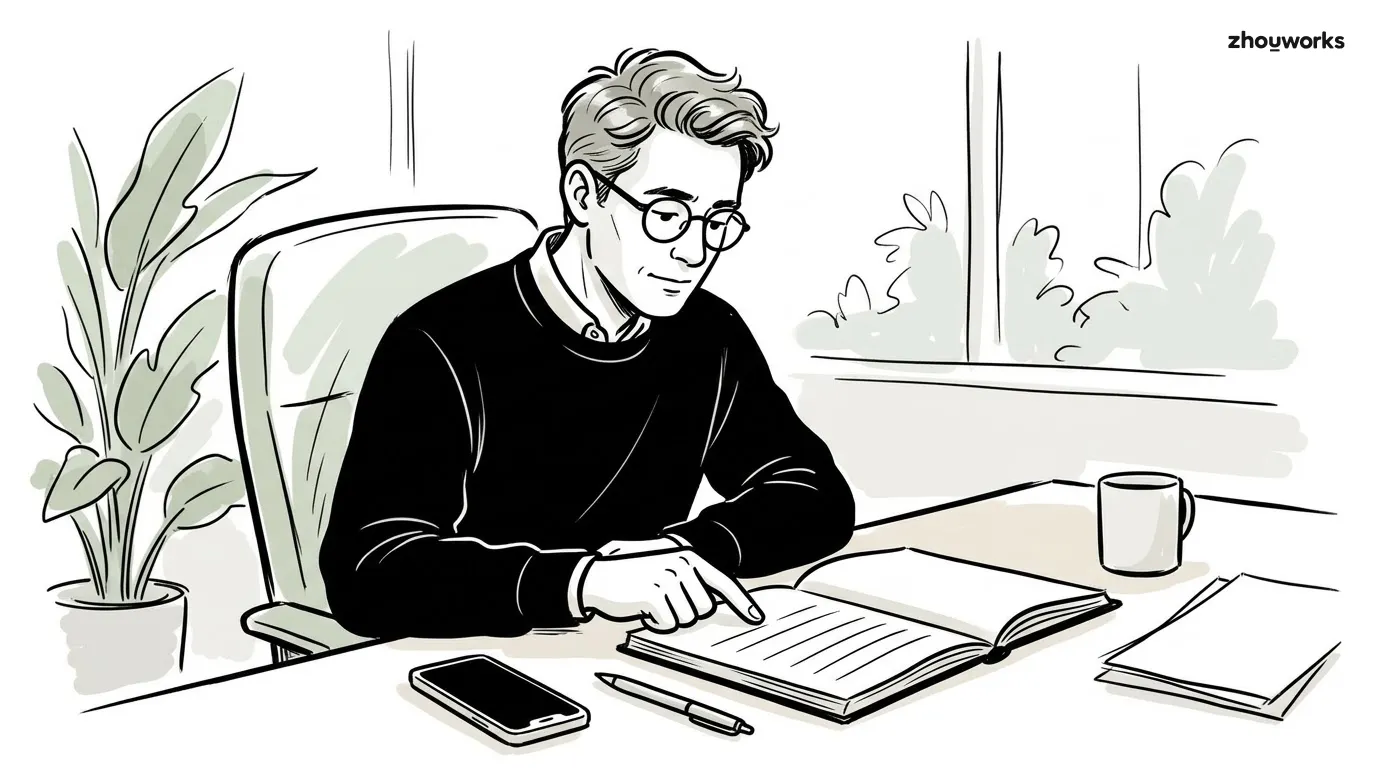
Do the line you wrote before you open the new message.
Three steps for getting back
The method has three steps, and the middle one is the only one that depends on what happened. First, write the next line before you leave: where you are, which action comes next, which file to open. Second, deal with what arrived: take the call, and for messages do now only what would make today's work wrong if it waited, sorting the rest as in protecting focus time. Third, do the line, then open the new messages: sit down, open the file, do the action you wrote, and only after that read.
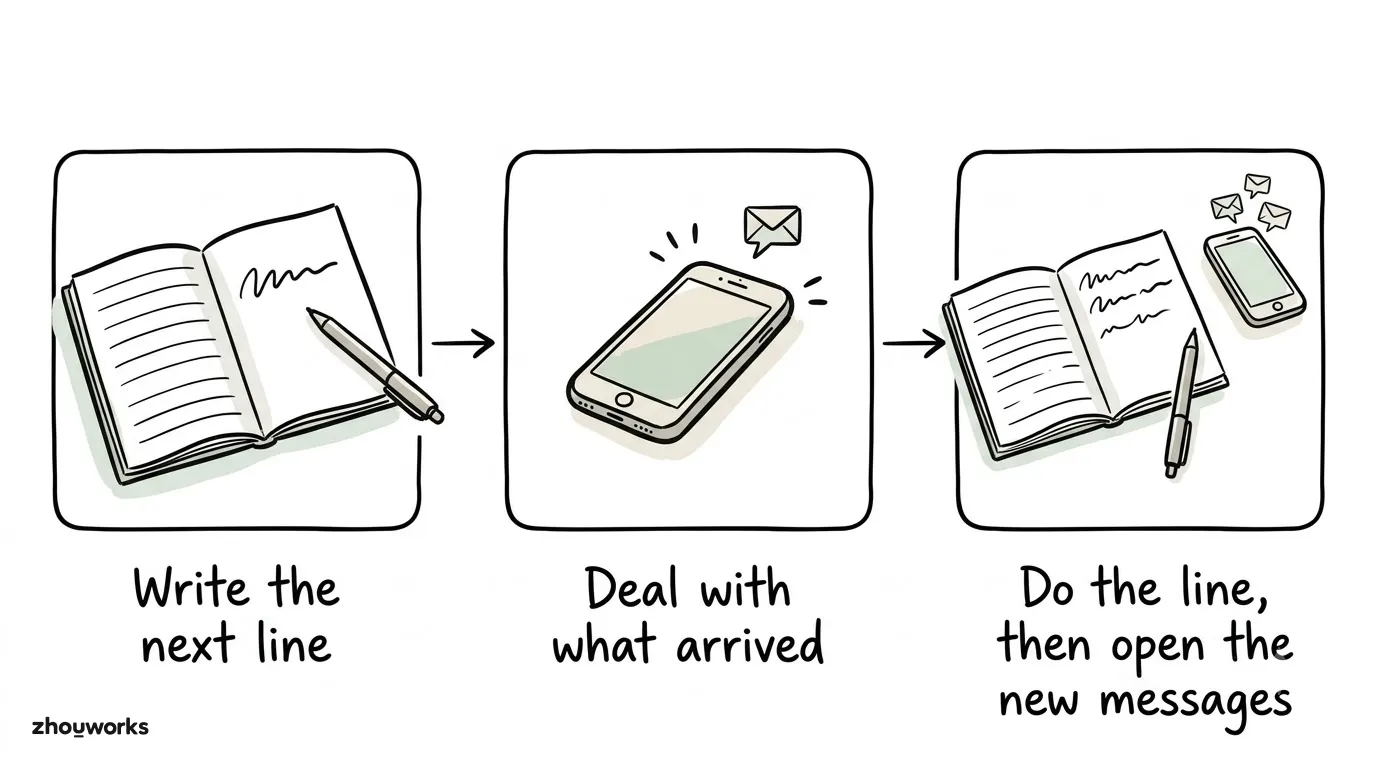
The order for getting back.
The order in step three is this article's proposal. If you open the chat first, new windows can pile up at the very spot you need to rebuild; do the written action first and you read messages with your head already back in the table. That small action is the thing you hold on to.
One afternoon with the line, one without
Take the same afternoon twice. It is a made-up scenario for illustration, not data, and the person with the line wins because the example was built that way.
At 14:10 two people are partway through the delivery cell when the phone rings, and both hang up at 14:20. The one who wrote a line sorts out the misdirected file, then opens the table and does what it says: ring the printer about the delivery fee. Five minutes later, at 14:25, they open the chat, which holds a question about the meeting time that can wait until 16:00 since nobody is blocked.
The one with no line opens the chat straight after hanging up. They answer the meeting question, open a file a colleague has just sent, and are back at the table by 15:00, 40 minutes after the call. Looking at the delivery cell, they can't tell whether they meant to ring the printer or just type a price, so the work slides into the evening as catch-up.
The line, written at 14:10, did not shorten the call. It stopped the next action from being replaced by the new messages and file.
Common mistakes
The commonest slip is writing a topic instead of an action. "Printer quotes" is a label, and when you sit down you still have to work out what to do first, so write a verb and an object. The second is a stale line: once the call turns out to run an hour, rewrite it at once as "delivery question still open, continue from this cell tomorrow", because an old line sends you to the wrong spot.
Where you write matters too. A note buried in a chat or an app sinks under new messages, while a scrap of paper beside the screen, or laid across the keyboard, stays put. And keep it to one sentence: a paragraph starts to look like a new task, and soon you stop writing it.
When does this not fit?
On-call shifts, call centres and any job that must answer continuously don't suit this, because the next action is always the next call. Keep the line for the blocks of work outside the shift.
This also loses when the call changes what needs doing: the old line then points to the wrong spot and has to be rewritten before you follow it.
After a morning without a single line, resist adding a longer form. One scrap of paper by the desk will do, written tomorrow before you stand up, even if it only says "delivery cell, ring about fee."
At the end of the day, look back at the interruptions
At the end of the day you can gather them into the ten-minute daily review. For interruptions alone, three questions are enough: what was interrupted, did the line help you get back (and if not, what was missing), and did the thing that cut in really need handling right then.
After a few days a pattern shows. If every interruption is a chat thread with no deadline, what needs changing is when you read the chat, as in reducing phone distractions. If the interruption is a call you have to take, the fix is not the ringtone but the line you write before you pick up.
Don't add up copies of 23 minutes and 15 seconds into "hours I lose each day." That figure is an average from one observational study, and your day won't automatically produce the same one. What to take away is simpler: one line written before you stand up, and one action done before you read.
Keep reading
Productivity9 min read
How to Reduce Phone Distractions at Work: A Three-Day Trial
Muting alerts may not be enough, because often you pick the phone up yourself. Three days: count, mute entertainment apps, then move the phone out of reach.
Productivity7 min read
Daily Review Template: Ten Minutes, Three Lines for Tomorrow
A ten-minute daily review in three lines: what finished, what is hanging and who acts next, and where to restart tomorrow. Worked example and a card to copy.