

A document is open, eight review comments left, and the phone lights up halfway through item 4. One alert is a file already sent to the wrong place. Another only asks the meeting time. Turning every notification off can hide the first kind.
For three days, keep the urgent route: the one call or channel that cannot wait. Pause one group of alerts nobody is waiting on. Write down what happens on a similar batch of work. A block is one stretch on that batch. The example uses 90 minutes because that batch took 90 minutes.
If you work alone and there is no on-call shift, the urgent route can be a client call, a family alert you are the contact for, or a deadline that expires today. The example below is a coordinator reviewing comments inside a team, so a filled log row is visible. The same split still applies when there is no shift.
At the end you know one thing: keep that one pause, put the settings back, or keep the pause and change how you restart the task.
Which alerts have to get through?
The call, or the single channel named for something that cannot wait, still has to ring. The on-call number is the phone number one person has agreed to answer for that case. Shopping, social feeds, and ordinary questions can wait. If nobody has named that route yet, leave work channels alone and pause only personal alerts you are sure nobody is waiting on.
Four answers have to exist before any setting changes. What has to be handled during today's work? Who answers while you are in a block? Which number or channel do they use? How late is "late" for that route?
The answers have to be specific enough for a colleague to follow. For someone reconciling comments, one workable line is: a file already sent to the wrong place, or today's handover stuck on a missing item. "What time is the meeting?" is not that line.
When the urgent route is a phone call, "urgent response delayed" in the log means the call was missed, or returned only after the block ended. When incidents still arrive as chat messages, that column means nothing until the team writes its own reply limit. No single number of minutes fits every job.
In the hypothetical, the project chat carries both incidents and ordinary questions. The coordinator asks a teammate before muting anything.
"Don't mute that chat. Yesterday's wrong file only showed up there. Get a phone number first, and someone who will actually pick up."
They settle it in one pass. Incidents move to an on-call call. Ordinary messages wait for 11:00 and 16:00. The chat stays loud until both the number and the named person exist.
| Signal | What to do for these three days |
|---|---|
| Call from the agreed on-call number | Leave notifications on. Answer. |
| A family alert you are the contact for | Leave it on. Treat it like the on-call number. |
| Ordinary project chat | Read it in two windows, if your role can delay it |
| Shopping or social apps | Pause push notifications |
| A reminder that expires today | Keep it on the calendar or task list |
This is a personal sorting of alerts, not a company security rule. On a phone the organization manages, follow the device and app rules. An app that policy says must notify you is not a candidate for the mute.
Working alone, with a client who messages at odd times, uses the same split. Calls from that client may be the urgent route. Casual messages move to the two windows only if the client has accepted the hours. If the relationship cannot wait, their channel stays as it is. What you can still pause is shopping and social apps.
What should the three days record?
Write down each time the phone pulls you off the unfinished task during the block. A new tracking app is unnecessary. A few lines at the bottom of the document, or a slip of paper by the desk, will do.
An interruption is one unlock or one answered call inside the block.
- Count it: an unlock with no alert, including a "one-second" unlock at a hard sentence. Mark it self-initiated.
- Count it: an answered call, including the on-call number. The comment list still stopped.
- Do not count it: a banner you see and ignore without leaving the document.
- Do not count it: the two reply windows you already scheduled, unless that window spills into the block.
- Urgent-response cell: mark "not delayed" only inside a limit the team already wrote down. With no limit, leave the cell blank.
Day 1 records the phone as it is
The walk-through below is how the sample row in the table was filled: review 8 comments, 6 interruptions, 5 of 8 finished, no delayed urgent response. It shows one morning on paper. It is not a measurement from a real group.
On a Tuesday morning the coordinator blocks 90 minutes for those 8 comments. No notification setting changes yet.
Just after 8:12 the chat banner says "urgent." It is a question about the meeting time. The coordinator notes the open spot, item 4, the payment sentence, and counts one interruption. At 8:27 the on-call number rings about a file sent to the wrong place. The call is answered immediately, so the urgent response is not delayed. It still counts as an interruption, because the comment list stopped. A real incident call is not a failed trial.
At 8:41 a shopping alert gets opened and closed. That is another count. Item 6 is a dense sentence. No alert is waiting, and the phone is unlocked anyway. The note says self-initiated, not a push. That distinction matters on day 3: if shopping is already quiet and this kind of unlock remains, the next change is not another mute.
A same-day calendar reminder is opened and the list is resumed. The reminder stays enabled. The unlock still counts, because the comment was left. Near the end of the block, one more ordinary chat message is answered inside the session, and the line being compared is lost.
The block ends at 6 interruptions, 5 of 8 comments done, and no delayed urgent response. The three unfinished comments stay recorded as unfinished. They are not converted into a percentage caused by the phone. Item difficulty and whatever else landed that morning also moved.
Day 2 changes one group and leaves a restart line
Before muting anything, place a test call from the on-call number to the phone where you will actually leave it: a pocket, the desk, or a drawer. If it rings, that spot is usable for the trial day. If it does not, move the phone. Do not solve a missed ring by muting the on-call number.
Pause push notifications for shopping and social apps only. The on-call number still rings. Ordinary chat waits for 11:00 and 16:00, which the coordinator already told the team.
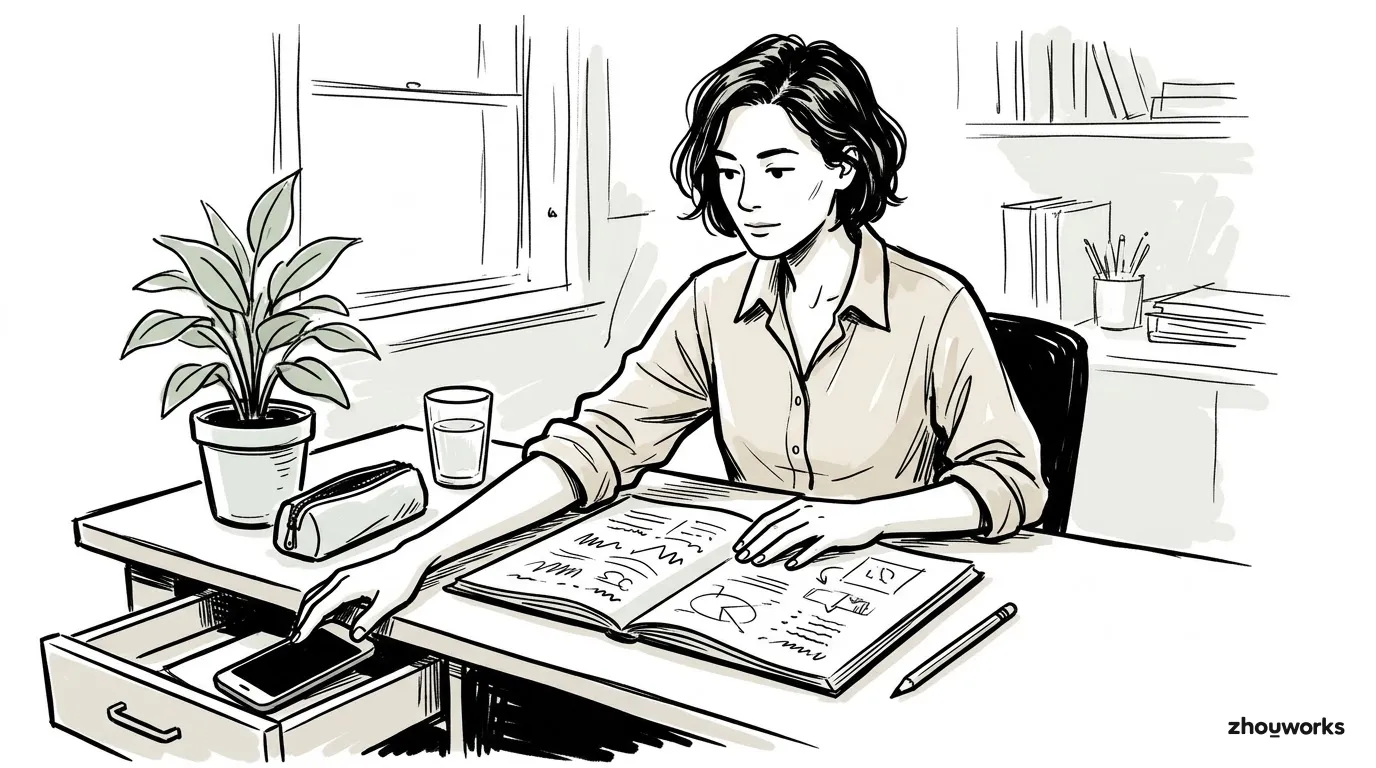
At 11:00 the chat is opened and ordinary messages get a reply. Anything that matches the incident line becomes a call to the on-call number, not a long thread. In the example the window closes after 15 minutes even if ordinary messages remain. The rest waits until 16:00. Fifteen minutes is the stop this example uses so the window cannot swallow the next block. Pick another stop if you need one. A window with no stop becomes the rest of the morning.
Before answering a call that cannot wait, or a message that cannot sit until the next window, write one line in the document that is already open:
"Item 4. Comparing the payment sentence with yesterday's copy. Resume at line 2."
The line names the spot and the next action. "Still working on it" does not tell you where to resume. If the call ends and the line was too vague, make the next one more specific. That is not a reason to mute another app.
Francesco Cirillo's account of a Pomodoro session describes one activity, a break, and a record of interruptions. These three days borrow the record. They do not make a timer the task. For a full session built around one activity, see how the Pomodoro Technique is used and when to adjust it. For choosing a long block or a short one around a single deliverable, see Deep Work and Pomodoro.
Day 3 runs one more similar batch, then compares
On day 3 you sit one more comment-review block of about 8 items, with day 2's settings left as they are. A day of back-to-back meetings, travel, or incident duty is the wrong comparison. Then compare three columns with day 1: comments finished against comments planned, interruptions inside the block, and whether any urgent response was late.
A lower interruption count does not show that notifications caused the change. Same kind of work means the same sort of deliverable, a batch near 8 comments, and a day that is not mainly meetings or on-call coverage. Eight comments against forty, or against a day of sending mail, is a different kind of work. A meeting day produces fewer unlocks even if the settings never changed. A drop from 6 to 2 across those two days says nothing about the mute.
The log you fill in
Day 1 repeats the example so a filled row is visible. Day 2 and day 3 are blank on purpose. The ellipsis is space for your own notes, not a missing statistic.
| Day | Planned deliverable | Phone interruptions | Output completed | Urgent response delayed? |
|---|---|---|---|---|
| 1 (example) | Review 8 comments | 6 | 5/8 | No |
| 2 | … | … | … | … |
| 3 | … | … | … | … |
When do you put the old settings back?
Restore the channel the same day if an agreed urgent call or message was missed. Tell the person covering, and stop pausing anything else. Waiting for the day-3 table leaves the team without the route you promised.
On-call shifts, live support, and jobs that require continuous watching should not treat the interruption count from a duty day as a result. During the shift the duty channel stays on. Shopping can still be paused. A keep-or-restore choice uses only non-duty days, and only the group you actually paused. For those roles the useful question is who is covering, not whether a duty day can be silent. How to shape a short block when the day is already full of interruptions is in protecting focus time.
A phone managed by the organization keeps required apps and alerts outside the trial. Pausing something on a personal phone does not mean the work phone may do the same.
If day 2 or day 3 is an all-day meeting, travel, or a long incident, mark the row "different kind" and repeat a comment-review day. Do not choose a setup from that row.
If the 11:00 and 16:00 windows collapse and ordinary chat is answered all through the block, the agreement did not hold, even with shopping already quiet. Say the hours again, or accept that this role cannot delay that channel. Do not pause a further app to compensate.
If incidents and ordinary messages still share one chat, stop the plan to mute that chat. Finish the agreement first. Until then, pause only apps that are clearly unrelated to the work.
Which phone setup do you keep?
Read four cases in order. Act on the first one that matches your three days, then stop.
If day 2 or day 3 was not the same kind of work as day 1, do not choose yet. Run another day like the comment review, then read on.
If the urgent route was late, or there is still no on-call number and no named person to answer it, restore every work channel you changed. One sentence the team can hear: "I turned notifications back to how they were. Urgent messages and ordinary messages are still in the same place, so I am not muting that channel."
If the paused apps are quiet and you still unlock the phone at a hard passage, while a file loads, or just after a meeting, keep that pause. Do not add another. The next change is the restart line and a smaller deliverable for the following block, not a longer mute list.
If none of those cases match — the urgent route held, only one group was paused, and the days were the same kind of work — keep that group and the two reply windows. Do not pause a second group next week. One sentence the team can hear: "This week I'm leaving shopping and social notifications off. Urgent calls still come through the on-call number. I'll read ordinary messages at 11:00 and 16:00."
| The question you just answered | What you do next |
|---|---|
| The comparison days were a different kind of work | Don't choose yet. Repeat on a similar deliverable |
| The urgent route was late, or there is still no call route | Restore settings. Agree the on-call number |
| You still unlock the phone while that group is quiet | Keep the pause. Write the restart line. Don't pause anything else |
| The urgent route held, and only one group is paused | Keep that group and the two reply windows |
The sample morning does not choose on day 1. On day 2, shopping stays paused only if the wrong-file call still gets through. If item 6 still produces an unlock after shopping is quiet, the matching branch is a self-initiated unlock. Day 3 confirms that branch only when the block is still the same kind of work as the 8 comments.
Keep reading
Productivity9 min read
A Ten-Minute Daily Review for Busy Workdays
Close the workday with a ten-minute review, three practical questions and a clear restart note for tomorrow.
Productivity12 min read
Time Blocking: Plan a Realistic Day Around Deliverables
Build a realistic time-blocked workday with defined deliverables, buffer time and a practical end-of-day review.