

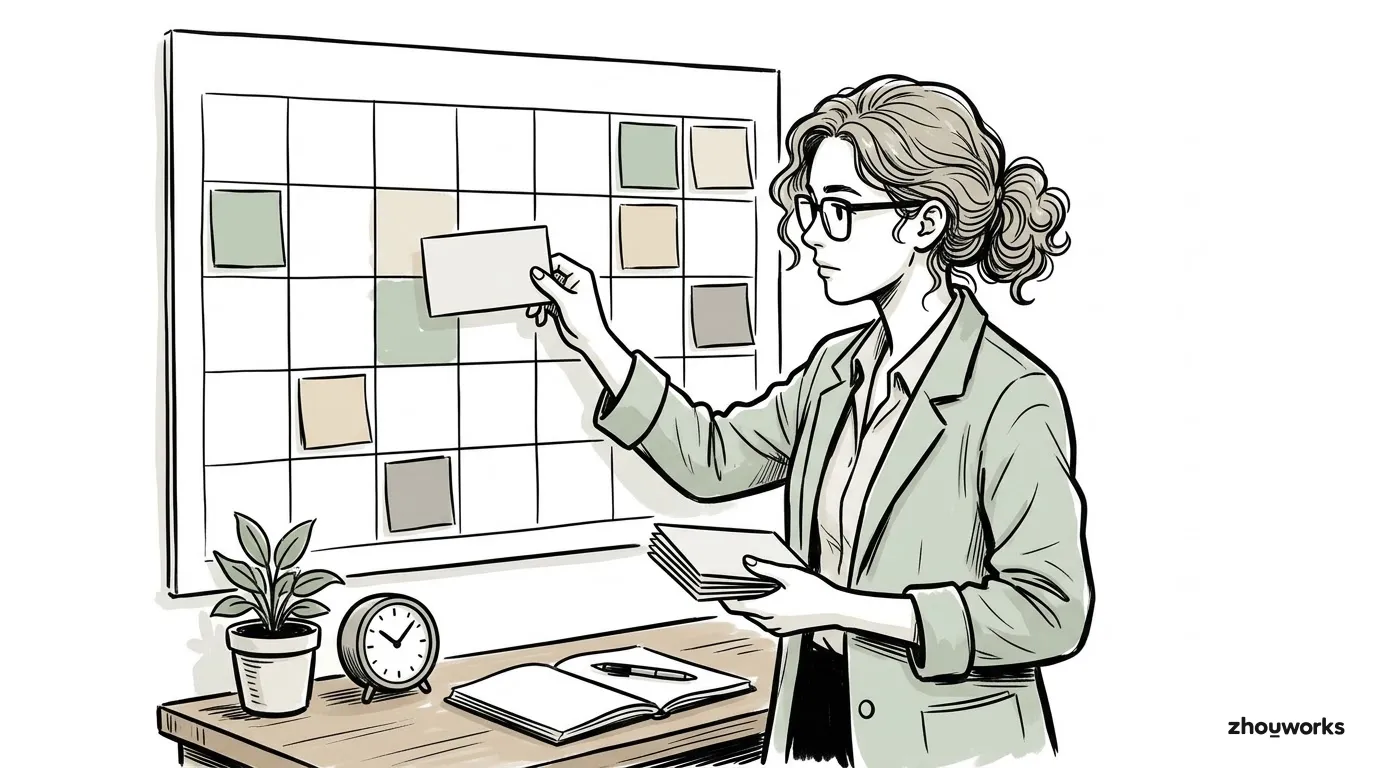
A calendar filled from 8 a.m. to 5 p.m. can look disciplined. One meeting that runs late may collapse the rest of the day. Time blocking reserves calendar space for a type of work in advance. Its value is choosing where attention goes while leaving room for uncertainty.
Define the deliverable before drawing the block
A coordinator reviewing drawing comments needs a stopping point. “Work on drawings” gives none. “Classify ten comments and write three questions for the designer” provides evidence of progress. Put fixed meetings into the calendar first. Estimate the remaining tasks, then leave buffer time. An estimate is not a guarantee.
Example: a day with two meetings
| Time (illustrative) | Work or deliverable | Evidence |
|---|---|---|
| 08:30–09:15 | Review drawing comments | Ten comments classified |
| 09:15–09:30 | Buffer | Handle a request or take a break |
| 09:30–10:30 | Project meeting | Decisions and owners recorded |
| 10:30–11:00 | Email and responses | Reply, schedule or delegate |
| 13:30–14:15 | Close the issues table | Three open questions assigned |
| 14:15–15:00 | Coordination meeting | Next milestones agreed |
| 15:00–15:30 | Buffer and reset | Replan remaining work |
Empty space is part of the plan. For an on-call role, agree on coverage and response expectations before protecting long blocks.
Run the plan in three passes
- Before work: choose one to three outcomes, fixed commitments and external dependencies. Put demanding work where your own energy tends to be sufficient; there is no universal peak hour.
- During work: assess a new request's urgency. Move a block if priorities change, record why, and avoid treating missed blocks as time debt. Before switching, capture the current state, the next action and the file to reopen.
- At close: record what shipped, what moved and what interrupted the schedule. After three days, adjust block sizes and buffer based on observed work rather than an ideal template.
Copy this block-planning card
- Outcome: …
- Evidence of completion: …
- Calendar block: … to …
- Fixed meeting or dependency: …
- Buffer: …
- Restart point if interrupted: …
- End-of-day decision: completed / moved / dropped
If your job is mostly reactive support, reserve flexible blocks for work categories instead of prescribing each minute. For an interruption triage method, see protecting focus time. To compare the plan with observed work, start with a time audit.
Reference: Cornell Learning Strategies Center – Managing Time discusses fixed commitments, flexible work and rest. The workday and planning card here are original illustrative examples.
Keep reading
Productivity2 min read
Protect Focus Time on an Interrupt-Driven Day
A practical three-day experiment for protecting focus during an interruption-heavy workday.

Methods3 min read
The Pomodoro Technique: A Practical Guide to Focus Sessions
A practical Pomodoro guide with an engineering workflow example, session tracker and rules for adapting timing.