

A site engineer walking level 8 sees paint peeling on the entrance door of unit 8.2, and the balcony door has not arrived. She writes "8.2 door bad" in her notebook. Two days later the finishing crew asks which door and which drawing, because a newer drawing file has landed in the group chat in the meantime. Nobody can answer quickly. Unit 8.2 is a hypothetical example used through the rest of this article.
A punch list in construction is the list of work that is still missing or does not match the drawings and requirements the team is allowed to build from, written down so it gets fixed before handover or final payment. Dictionary.com calls it an itemized list of mostly minor fixes to be done before final payment on a construction or repair job. Wikipedia describes the same list near the end of a project: work that does not conform to the contract drawings and specifications. Crews also say defect list, and in British usage the usual name is snag list.
The point of this article is that a punch list earns its keep in two places. Each line must be clear enough that someone who was not on the walk can fix the right spot. And a line closes only after somebody looks at the repair, not when the contractor says it is done.
How is a punch list different from a checklist?
A checklist is what you plan to look at, including places where nothing is wrong yet. A punch list is what you have already seen and still has to be corrected. "Check doors" does not say which door, what is wrong, or who fixes it. A punch-list line says all three. A punch list is also not the site report: the report says who walked and which area, while the punch list is the repair lines, so each crew can filter its own work.
Wikipedia's examples include a broken window, stained wallboard, cracked paving, a missing light, an unconnected faucet and peeling carpet. Who writes the list, when the job counts as complete enough to hand over, and which money is held back until items are confirmed are questions for each project's contract. This article does not replace those terms or any form a public authority requires.
What does one line in the list need?
Each line should make sense when the person fixing it was not on the walk. For unit 8.2, a usable line looks like this.
| Field | Unit 8.2 example |
|---|---|
| Place | Level 8, unit 8.2, entrance door, viewed from inside |
| Drawing | A-08, revision C, the issued sheet |
| What you saw | Paint peeled beside the hinge, about a hand's width |
| Work required | Scrape and repaint to the colour code on revision C |
| Photo | One close photo and one step back, same direction |
| Who fixes it | Contractor A finishes crew |
| Due | Before Friday's recheck |
| Status | Open |
A revision is the issue letter of a drawing. Write it down because the newest file on your phone is not necessarily the one you may inspect against. In unit 8.2 revision C is the issued sheet; revision D, which just arrived in the chat, is not. Without the revision, someone opens D tomorrow, sees a different requirement and decides the defect is gone. With only "bad paint", the crew may repaint the door of unit 8.3.
A photo helps only when another person can tell where it was taken. How to shoot that is covered in taking site photos.
How do you run a punch-list walk?
Before you start, answer three questions. Which drawing is issued for the area you are about to walk? Is this item installed and wrong, or not installed because the trade has not reached it? Who fixes it, and who checks the fix? If you cannot answer the first, do not write yet. The method below, including the three statuses in a later section, is this article's suggestion, not something taken from Dictionary.com or Wikipedia.
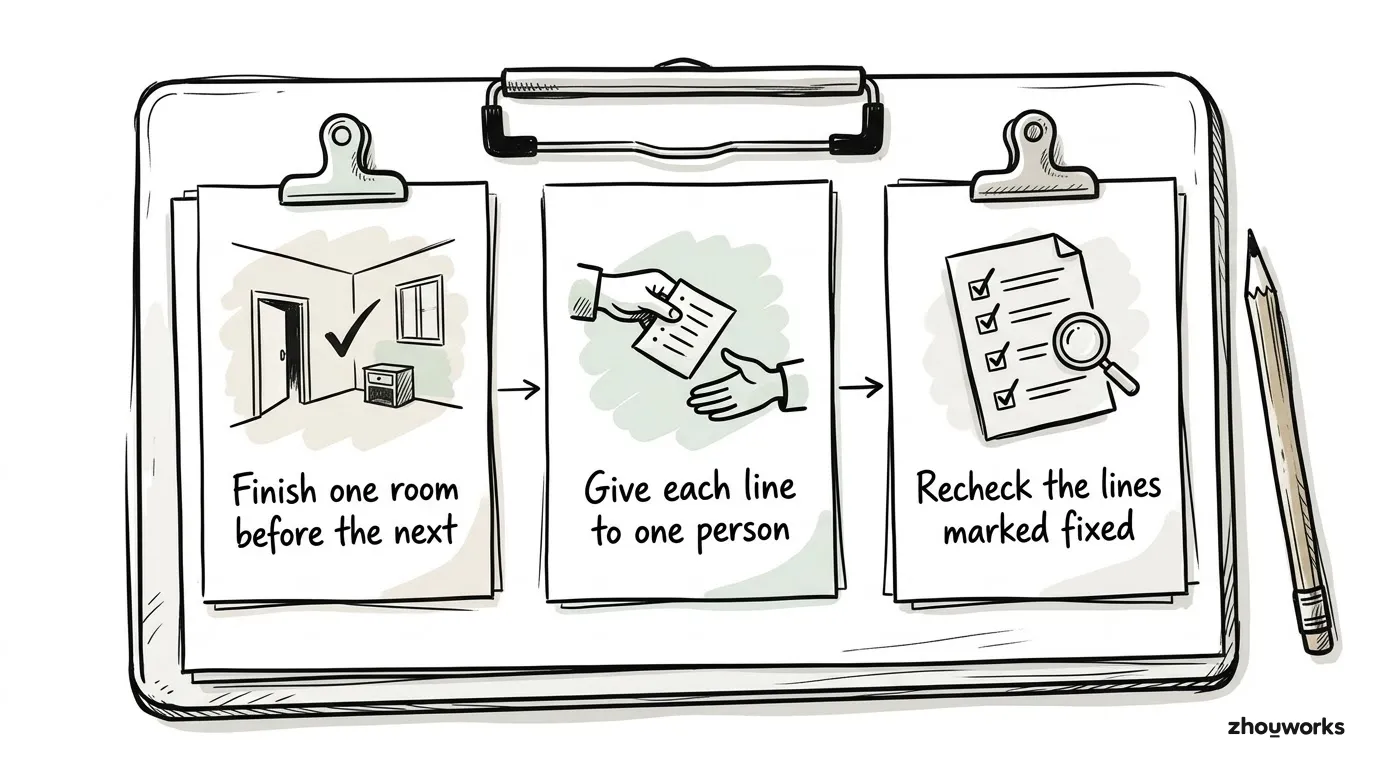
Settle the drawing first, then finish one room before the next, so the list does not collapse into one pile.
The main path has three steps.
- Finish one room before the next, one line per defect. Each line carries the place, the drawing and revision, what you saw, the repair, and photos attached to that line. At the end of each unit, read your lines back and fill any that lack a place before you leave the floor.
- Give each line to one person, with a date. The person acknowledges it with the time. Without an acknowledgement, the argument tomorrow is that the list was never handed over.
- Recheck the lines marked fixed, then close them. The recheck visit carries only the lines marked "fixed, waiting check". Bringing the closed lines slows down the ones still hanging.
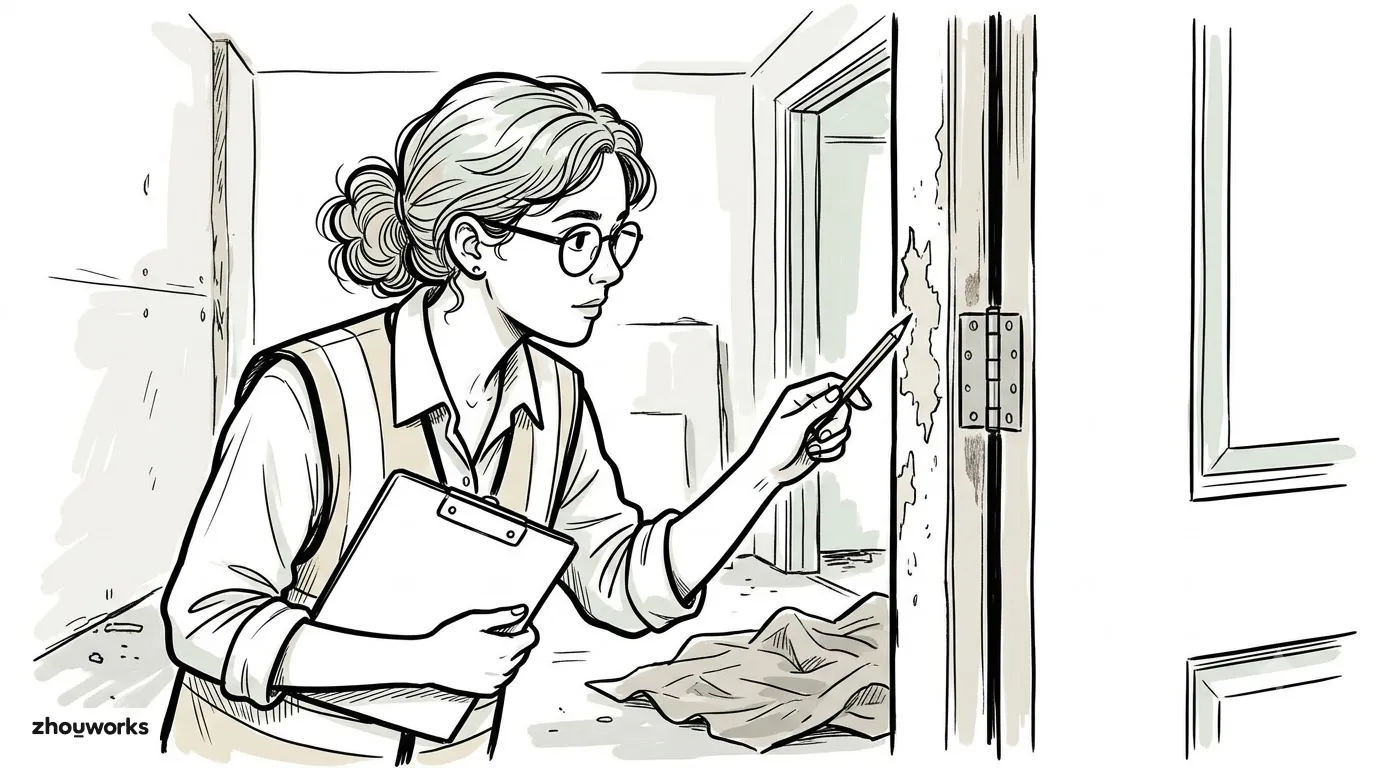
Each line names a place you can stand in, then the defect, then who fixes it.
In unit 8.2 she also sees an outlet that does not match the electrical plan. The outlet belongs to E-08 revision B, not to A-08, so the second line must cite the electrical sheet. "Level 8 drawings" tells the electricians nothing about which sheet to check. If three people walk together, one calls the room number, one writes, one photographs. If the photographer cannot point at the same door, the photo is not attached yet.
When does a line close?
A line closes when the person assigned to check looks at the finished work and accepts it against the drawing you are allowed to use. For a small fix the person who wrote the line made on the spot, looking again is enough to close it. "We painted it" does not close the line if nobody has compared the entrance door in 8.2 with the colour on revision C. Keep the statuses few:
- Open: written, not fixed.
- Fixed, waiting check: the crew says it is done, and nobody has checked.
- Closed: the checker has looked at the repair, on site or in a photo that clearly identifies the spot, and accepts it.
What belongs outside the main path?
- Blocked work. The missing balcony door is not the paint line. It is waiting on delivery, so record it where the project tracks deliveries, not in the paint line.
- Work that is not on this list. Extra work that needs a new instruction, for example. Note where it is tracked and take it off the punch list, so the list does not become every open argument on the job.
- A new revision. If revision D is later issued in place of C, read the open lines again. Some die because the requirement changed; some stay because the paint is still peeling. Do not delete the whole list because the letter changed.
- Too early. On a shell that is not finished, the list is outstanding work, not a handover list; mixing them leaves the coordination meeting arguing about lines that were never due. On timing, Wikipedia says punch lists usually appear when most work is installed, are often written by the owner, architect or general contractor on a walk, and final payment is commonly tied to items being confirmed.
How do you mark it on paper and on a PDF?
On a printed sheet, put the item number beside the location and use the same number in the table. If the sheet is crowded, write "see list, item 14" rather than a sentence across the plan.
On a PDF, place a marker or comment on the entrance door of 8.2 and type the same fields. This article does not name a program. The marker does not replace the sentence: a person opening the file on a phone still needs to read "entrance door, peeling paint, A-08 revision C". When a new revision is issued, keep the old markers until the open lines have been read against it; deleting first loses the work that is not closed.
A short list you can copy
Copy this onto paper or into a spreadsheet; blank cells are for you to fill.
| No. | Place | Drawing / revision | What you saw | Work required | Photo | Who fixes it | Due | Status |
|---|---|---|---|---|---|---|---|---|
| 14 | L8 / unit 8.2 / entrance door | A-08 / C | Paint peeled beside hinge | Repaint to the code on C | Yes, 2 photos | Finishes crew A | Friday | Open |
| 15 | L8 / unit 8.2 / kitchen wall | E-08 / B | Outlet off the electrical plan | Move to match B | Yes, 1 photo | Electrical crew B | Friday | Open |
| … | … | … | … | … | … | … | … | … |
Before you send the list, check three things: every line has a revision, every line has a person, and no line says "bad paint" without saying which door.
On site, a punch list is the list of work still to fix, tied to the drawing you may inspect against, with enough places and people to recheck it.
Keep reading
Methods7 min read
Construction site photo documentation that still points
Two frames and one written line for each defect, so the photo still points a week later.
Methods6 min read
Snag list vs punch list: what changes, what does not
Two names for a list of defects still open. One line still needs a place, a fix, and a person.