

At the end of a Thursday afternoon, the site supervisor posts in the team chat: "Level 3 is fine, we carry on tomorrow." The next morning the plumber asks which rooms are fine, and the homeowner asks why the bathroom door is still missing. Nobody can answer from that message, because it does not say which rooms were walked, against which drawing, or what is still short.
A site report, as used here, is a record of one visit to the site: who walked, which area, which drawing, what was seen finished, what was off the drawing, and what is blocked. A supervisor, a contractor's engineer or a homeowner looking at a house under construction can all write one. A site's daily report is a different document; this article covers one visit. A sentence reporting work is only usable when it names the drawing it was checked against and what is still missing, and the chat line has neither.
The visit below is hypothetical. A four-storey terrace house is being renovated, on a damp Thursday afternoon. The supervisor and the contractor's engineer walk level 3 with architectural sheet A-03 revision B, the issue letter of that drawing. A file labelled "revision C" sits in the chat, but nobody has issued it. The shared bathroom has wall tile but no grout, and the door frame is still empty. The rear bedroom has one coat of primer. The front bedroom, facing the street, cannot be entered because scaffolding blocks the door.
The two of them remember it differently. One starts to write "level 3 tiling done". The other corrects the line: "Tile is on, no grout, door has not arrived." Only the second sentence can be acted on by someone who was not there.
What does a site report need to record?
Write on the level itself, while you can still point at each room. Written back at the office, two similar things, such as the bathroom door that is not hung and the bedroom door that is not painted, tend to merge.
- Record the general details of the visit. Date, time, weather, who was present, the area walked, the area you deliberately did not enter, and the drawing used with its revision. A file that is not issued, like revision C in the chat, gets its own line and is not used for conclusions. The area not walked has to appear: if it is blank, the reader assumes the whole level was seen.
- Write each area in sentences that hold both the finished part and the missing part. Each area gets three kinds of line: work done, off the drawing, blocked. "Tile on, grout not started" replaces "fine". For what is off the drawing you only need an item number and one sentence; repair detail lives on the punch list, the list of each open repair. For blocked work say what it waits on: material, an issued drawing, or access. A door leaf that has not reached the store is written as waiting on delivery, not as a carpentry miss. If the two of you cannot agree on the spot, say one says the grout is done and the other says it is not, write both sentences, mark them unsettled and put the photo beside them. The recipient then knows to check the photo, rather than receive a sentence someone chose for them.
- Close with the recipient and the action before the next visit. The recipient's name, the time sent, who wrote it, and what they have to do. Without a name, nobody on the next morning knows who owns the line "door not hung".
If step 1 does not name the drawing, the reader cannot tell which drawing "matches the drawing" refers to: tomorrow someone opens file C, sees a different requirement, and decides the mismatch is gone. If step 2 does not say what the work waits on, a reader takes a missing door for poor workmanship when the door has not arrived.
The report and the punch list do different jobs. The report tells the story of the visit, so it carries the area not walked and the blocked work. The list keeps each open item so the right person can filter their own. One visit can produce both, but the report does not replace the list.
A walk through two or three rooms can have a short report. A whole block needs a section per level with all the items, because one paragraph for the block blurs which rooms are done and which are not. Make sentences specific enough that someone absent can act on them: "on schedule" names no room, while "bathroom tile is on, grout is not" does.
Template to copy
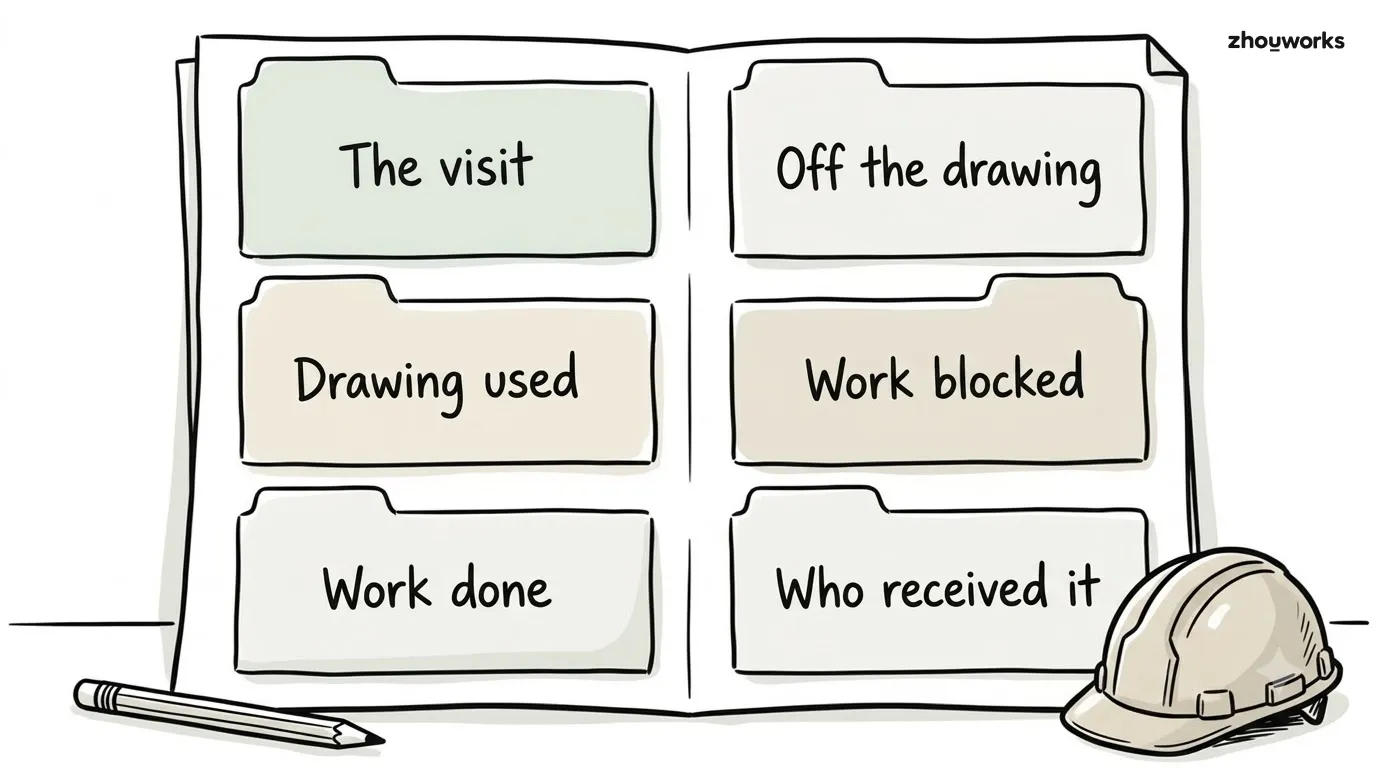
The six parts of the template, in the order you fill them.
When a contract or an authority names a form, use that form; this template is only a working record, not a statutory form. Copy it onto paper or into a file and fill the blanks. The lines with words are the Thursday afternoon on level 3; delete them on a real job.
The visit
- Project: …
- Date, time: Thursday, 15:10–16:40
- Weather: Damp, no rain
- Present: Supervisor A, contractor's engineer B
- Area walked: Level 3, shared bathroom and rear bedroom
- Area not walked: Front bedroom, scaffolding blocks the door
Drawing used
- A-03 revision B, issued for architectural work on level 3
- E-03 revision A for switches and outlets
- File "revision C" in the chat: seen, not issued, not used for conclusions
Work done
- Shared bathroom: wall tile complete, grout not started, door frame still empty
- Rear bedroom: one coat of primer on the walls, no finish coat
Off the drawing
- Item 7: shared bathroom, top course of tile sits above the level on A-03 revision B, see punch list
- Item 8: rear bedroom, light switch placed on the hinge side of the door, off E-03 revision A
Work blocked
- Bathroom door leaf is not in the store yet, waiting on delivery
- Front bedroom not entered because of the scaffolding
Who received it
- Sent to site lead C at 16:55. Before Monday: hang the door when it arrives, fix items 7 and 8, book the recheck
- Written by: …
- Receipt acknowledged by: …
Put photos next to items 7 and 8, not in an unnumbered dump at the end of the file. How to shoot so an absent reader can find the spot is covered in taking site photos.
Read it as the recipient
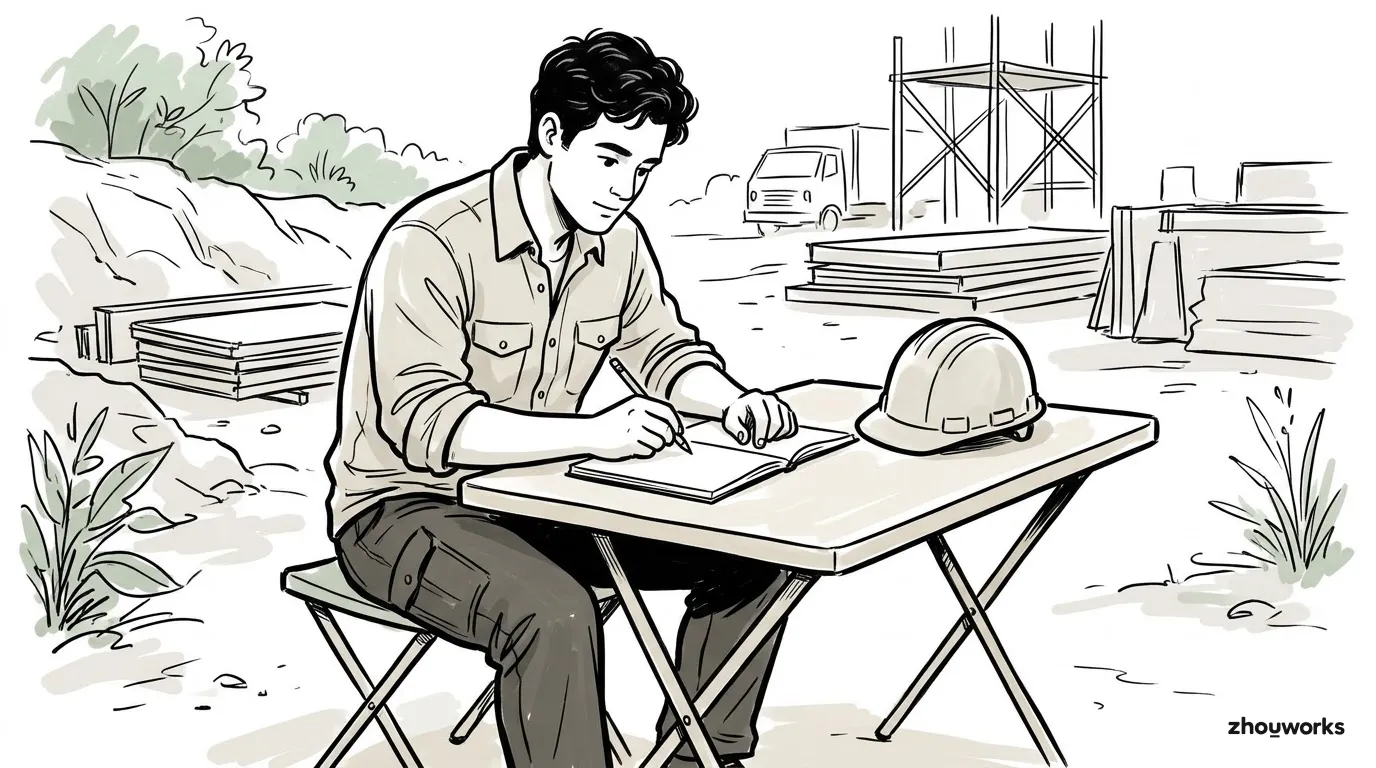
Write before you leave the site, while the door and the drawing are still in mind.
Read the report as the person who was not on the walk: someone who was there can fill in the gaps, the recipient cannot.
- Is the area you skipped written down?
- Does every mismatch have a punch-list number?
- Is an unissued file written as if it had been used?
- Does blocked work say whether it waits on material, a drawing, or access?
- Do the recipient's name and the next action sit at the end?
For this visit, the weak sentence is "level 3 is nearly done." The usable one is "bathroom tile is on, grout is not, and the door is missing because it has not been delivered; rear bedroom has one coat of primer; the tile and switch items are open; front bedroom not entered."
A report that goes out a day late still helps if those sentences stay true. A report that only says "fine" tells the recipient nothing about the real state, even when it goes out at once. If you spot a mistake after sending, note the time of the change and keep the old sentence, so someone who read the first version can see what changed.
Keep reading
Methods7 min read
Construction site photo documentation that still points
Two frames and one written line for each defect, so the photo still points a week later.
Methods6 min read
Snag list vs punch list: what changes, what does not
Two names for a list of defects still open. One line still needs a place, a fix, and a person.