A long technical chapter can feel clear on Friday and useless on Monday, because the sentence you needed is buried among examples. Keep three things: the author's claim, the condition or support printed beside it, and a check you can run before you use the claim.
Take a made-up afternoon. Lan coordinates project paperwork. Her lead has asked her to come to a meeting in forty minutes with an answer from one handbook chapter: how a reviewer differs from an approver, and whether finishing the review step clears the document for use. The handbook title in this example, "Technical Process Handbook," is invented. So are the page numbers. They show where a note should point. They are not a citation.
What question fits the time you have?
Spend the forty minutes on a budget, not on a vow to finish the chapter. In the example, about eight minutes go to the contents page, the figure and the closing note. About twenty-two go to the passages that match the question. About ten go to a short note and a choice about what she will say. A dense chapter, small type or a run of tables steals time from the first block and gives it to the second. The last block stays. Dropping the note so you can claim you finished the pages leaves you with nothing to say.
Lan's question, written before she reads: "In this chapter, what does the reviewer do that the approver does not, and does review alone clear the document for use?"
That wording lets her skip headings. If a later section answers a different problem she actually has today, she crosses out the old question and writes the new one. Keeping a question she no longer needs spends the break on pages the meeting will not use.
Cornell's Learning Strategies Center suggests naming a purpose, previewing, and planning how you will use what you read. The page is written for students. The same three moves fit a work chapter: they tell you which pages to open. They do not come with a memory score you can expect.
The invented contents list has four headings: roles, one sample approval path, advice for a small team, and the limits of the example. The figure is a set of arrows, captioned as one way a team might arrange the work. The closing note says the example is not a contract clause. Lan stays, because the chapter looks able to answer her.
She would leave at minute eight if no heading mentioned the two roles or whether the document may be used. The note would say "this chapter does not answer it," and she opens the project procedure next. An open book is not a reason to finish it.
Before reading, four blanks are enough: the question, the heading most likely to hold the answer, the minutes you really have, and what you will be able to say if the session worked. For Lan, the session worked if she can explain the two roles and say whether review alone clears the document. Time that runs out before she can say both is an unfinished session.
A course that starts next month is a different job. Then the output is the question plus a few page numbers, and you never lay a sample permission table beside the project's. Someone who must act this afternoon has to pick one result before they speak. Those two jobs are not the same length.
What kind of sentence is this?
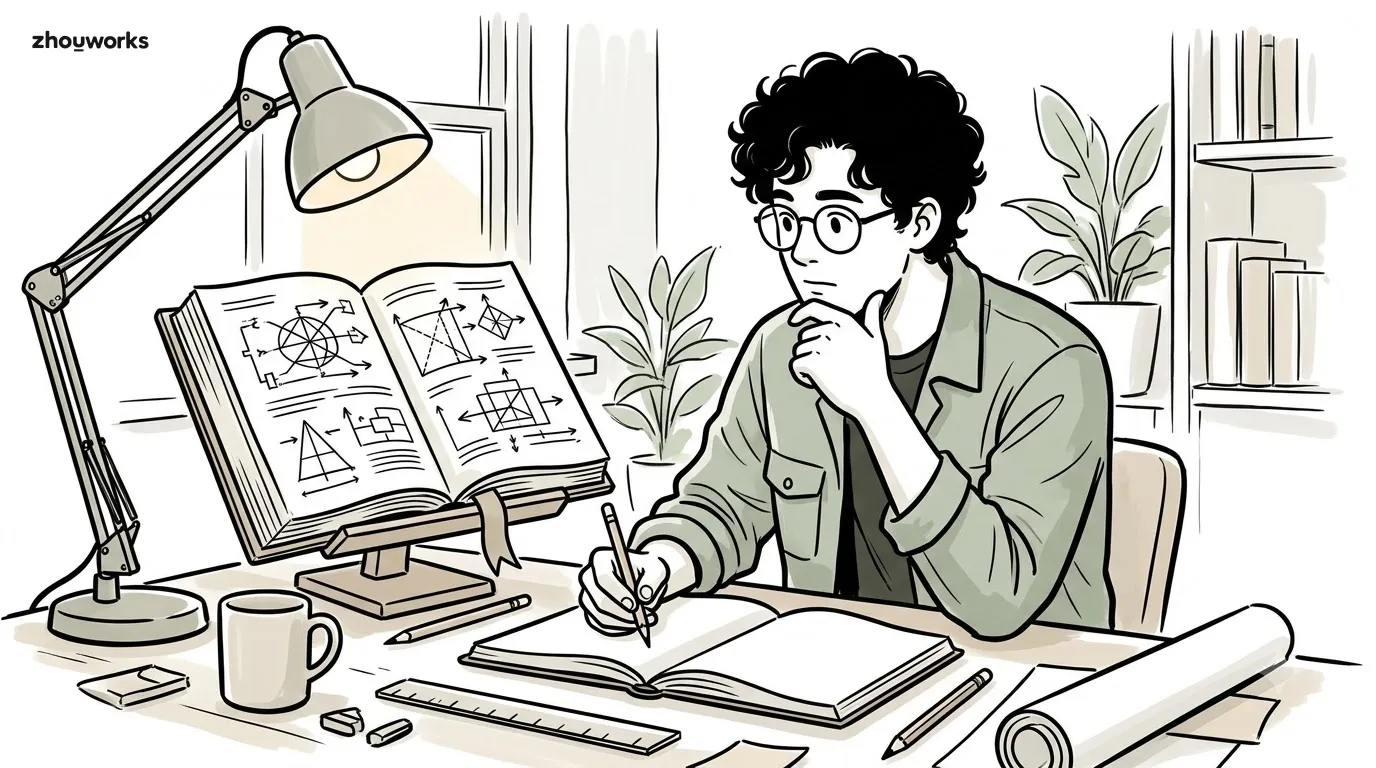
Ask what the author is doing in this sentence. Four kinds cover the chapter: definition, example, advice, and requirement. They are a way to read, not a standard's classification or notation. A line in the book is not yet the project rule. A workflow drawn on the page does not, by itself, become a feature of a product.
Page 41 is a definition. A reviewer checks the document against a list. An approver accepts it for a stated use. Your own organization may use the names differently. The note says "definition in the book" and the page.
Page 44 is an example. It draws author, then reviewer, then approver. Lan copies the caption, because the caption is what limits the drawing: one way a team might arrange the work. The arrows are not her organization chart.
Page 47 is advice. On a small project, if no second person is available, one person may both review and approve, and should record that choice. "Small project" and "no second person" are the part worth keeping. Without them, the sentence turns into "one person does both jobs." The book does not say that, and it does not require every small project to combine the roles.
Page 49 is worded as a requirement. The document shall not be used for construction until the approver records the permitted use, the use written down as allowed. The note says "worded as a requirement in the book," not "our rule."
A governing document is the contract, the original standard, or the project procedure.
| Example page | Kind of sentence | What to keep |
|---|---|---|
| 41 | Definition in the book | Review checks; approval accepts a stated use |
| 44 | Example, with a caption | The three-person figure is not the project's chart |
| 47 | Advice, with conditions | Only a small project with no second person |
| 49 | Worded as a requirement | Not yet a project rule; open the governing document |
On paper, underline if, when, only, not yet, shall and must. A private margin mark is fine when nobody else will read the note this week: DEF, EX, ADV, REQ. Spell the words out if the note will be handed on. On a screen, file one line under the book title so the meeting opens on the right page.
A sentence that is two kinds at once
Page 49 also smuggles a definition: "cleared for use" means someone has recorded a permitted use. Write both labels, and act on the stricter one. Safety, a contractual duty or access rights mean you do not decide from that sentence. Keep the definition with the page anyway, so you still know how the author is using the word.
A figure with no caption
No caption means you cannot tell an example from a required path. Write "figure, no caption" and the page, and leave the figure as a picture. If the chapter quotes a standard, copy the name and the clause number as printed. The sentences around the quotation are still the author's. No clause number on the page means the note says "clause not given," and the check waits for the original document.
When the chapter describes clicks in Autodesk Forma or any other product, check the version and the vendor's current documentation before you treat the clicks as still true. Print usually lags the software. Label the sentence with the four kinds above. The file that can confirm the clicks is the vendor's, for that version, not the project's staffing procedure.
What do you keep after the session?
What Lan carries out of the room is three lines, not a copy of the chapter. Cornell's textbook reading page describes reading to a question, summarizing, and trying to recall, adjusted to the material in front of you. It does not give one success rate for every book. She covers the note and says the answer once.
In her own words, the reviewer checks and the approver accepts a stated use. On the sample path, review alone does not clear the document. She still does not know whether her project splits the roles as page 41 does, or whether one person may hold both on a small team. The safe test is to lay the chapter's sample permission table beside the project's: reviewer may comment, approver may release. She does not change a live permission to see if the book sounds plausible.
If that retelling loses "small project" or "not for construction," she opens page 47 or 49 and repairs the first line. The missing phrase names the page. It does not send her back through the chapter. Coming back days later is covered in how to remember what you read. With a meeting next, one retelling is the stop.
Cornell's note on digital reading allows the platform's tools or pen and paper. Use whichever you can reopen in the meeting, a notebook page or a note stored with the book title. A new filing system does not fit this break.
A forty-minute read ends when she can say the answer and name the document still closed. For the next chapter, copy seven blanks and fill them: book, edition, chapter and pages; the question you brought; the answer in your own words; two sentences still to check, with pages; the governing document you will open; one test that leaves the live system alone; and the result of that test, including "not run yet."
Which result do you choose before you act?
Before she speaks in the room, she gives the sentence one result.
Enough to discuss. She can state the answer, the page and the condition, and she names the document still closed. She does not say the book binds the project.
Not in this chapter. Preview showed it, or the passages still do not answer. She stops and names what she will open next.
Closed until the governing document is beside the book. Choose this when the sentence touches safety, a contractual duty, or who may open a file.
If the meeting only wants the chapter's wording, pages 41 and 44 take the first result. Page 47 takes it only when both conditions are spoken aloud. A proposal to build from page 49 moves that sentence to the third result. The page does not keep a permanent label. A later session might need the definition and nothing more, so "never use page 49" would be the wrong note to file.
Where the chapter and the project procedure disagree, she writes both sentences and the location of each. Someone who already knows the project rule, and is only looking for drift, marks the page that matches or the page that conflicts and skips the permission-table test.
Read slowly on the third result. An introductory chapter gets a preview and a return visit to the pages that answer. A pile of reading you cannot find again is a filing problem, and another chapter will not fix the pile. Notes while reading is about finding the line later.