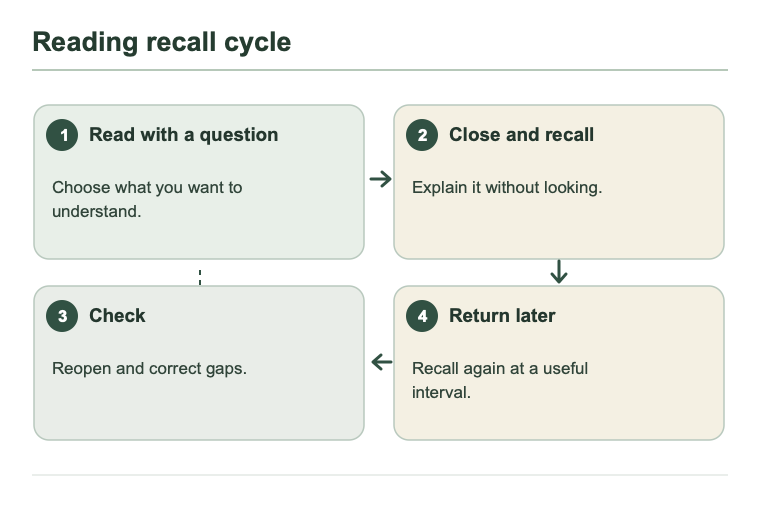
You finish a chapter and struggle to recall its main point. Instead of trying to memorise every page, choose an idea you actually want to use, try to recall it without looking, check the book and return to it after some time.
This routine is useful when you are reading to learn or apply something. A novel you pick up to relax does not need to become a test after every chapter.
Start with a question
Choose something you want to find out, such as “What could make my next meeting clearer?” The question helps you notice relevant passages. You can change it if the book takes you somewhere unexpected.
You do not need to save every detail. Keep one or two ideas that answer your question, together with the book title and page number so you can return to the context. If a number or recommendation affects an important decision, keep the source for checking rather than relying on memory alone.
Close the book and try to recall
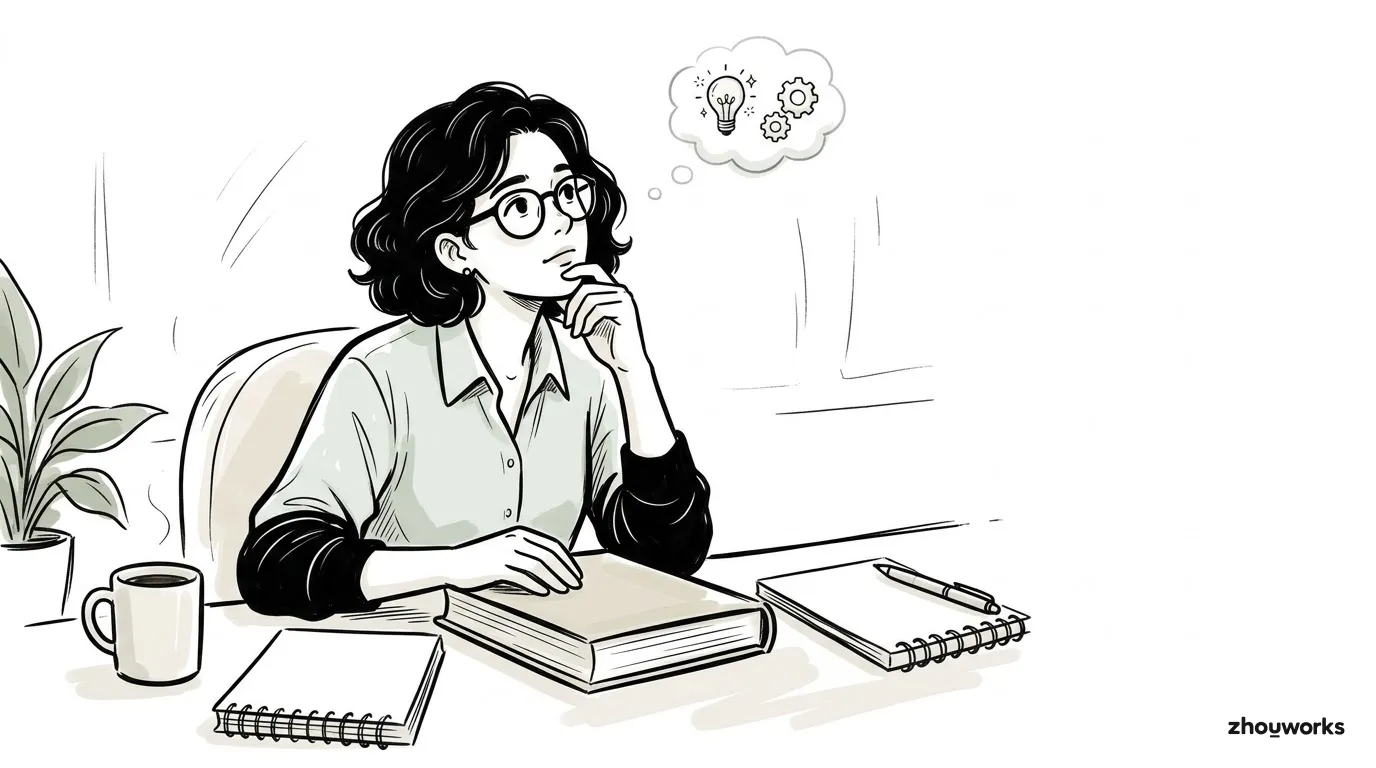
Close the book and try to recall before opening your notes.
Choose an important passage, perhaps a few pages or one section, and spend a few minutes trying to recall it. You do not need to run through every step for every passage. Close the book and answer in your own words: “What was the main idea? How did it answer my question?” You can write a few lines or say them aloud. A gap is useful information: it shows you where to look again.
For example, imagine reading about meeting preparation and recalling: “Before inviting people, clarify the decision the meeting needs to make.” Reopen the book to check for conditions you missed, correct your note and add the page number. This is an invented example, not a quotation from a particular book.
Cornell's Learning Strategies Center calls active recall retrieval practice. Its guidance is aimed at studying; you can adapt the approach to reading a book, but it does not imply the same outcome for every reader or text.
Return after a gap
Set a reminder that fits your life, perhaps at the end of the week. Look at your question and try to answer before opening your note. Then check that idea against the book and fill in what you missed. If a question remains, you can write it down. You can leave a longer gap next time if you remember the idea and still find it useful.
Cornell also recommends spreading study sessions over time rather than cramming. There is no mandatory 2–7–30 schedule or guaranteed percentage to remember: choose intervals that fit the material, your purpose and your time.
Give an idea somewhere to go
An idea is easier to find again when you know where you might use it. For the meeting example, you could write: “In the next invitation, add a sentence naming the decision to be made.” After the meeting, consider whether this helped people prepare and adjust next time. This is a way to try an idea, not proof that the book's advice always works.
To keep ideas organised, try the reading-note template. For help engaging with a book from the start, see the active reading guide. A useful book does not require you to remember every page; it helps to be able to find and use what matters.