You finish a chapter and want to keep an idea. Should you make a page that is easy to review, or save an idea on its own so you can connect it with others later? Cornell notes and Zettelkasten support different kinds of work. You can use either or combine them.
Try Cornell when you want a page for reviewing one lesson or chapter. Try Zettelkasten when you want to develop a connected collection of ideas across sources. You do not need to replace your entire system or buy an app to experiment.
Cornell: a page for understanding and review
A Cornell page typically has a main notes area on the right, a cue or question column on the left and a summary at the bottom. Cornell's Learning Strategies Center describes recording notes, writing questions, answering them with the notes covered, reflecting and reviewing. It is a study method; you can adapt it to a book chapter.
For a fictional passage about meeting preparation, a Cornell page might look like this:
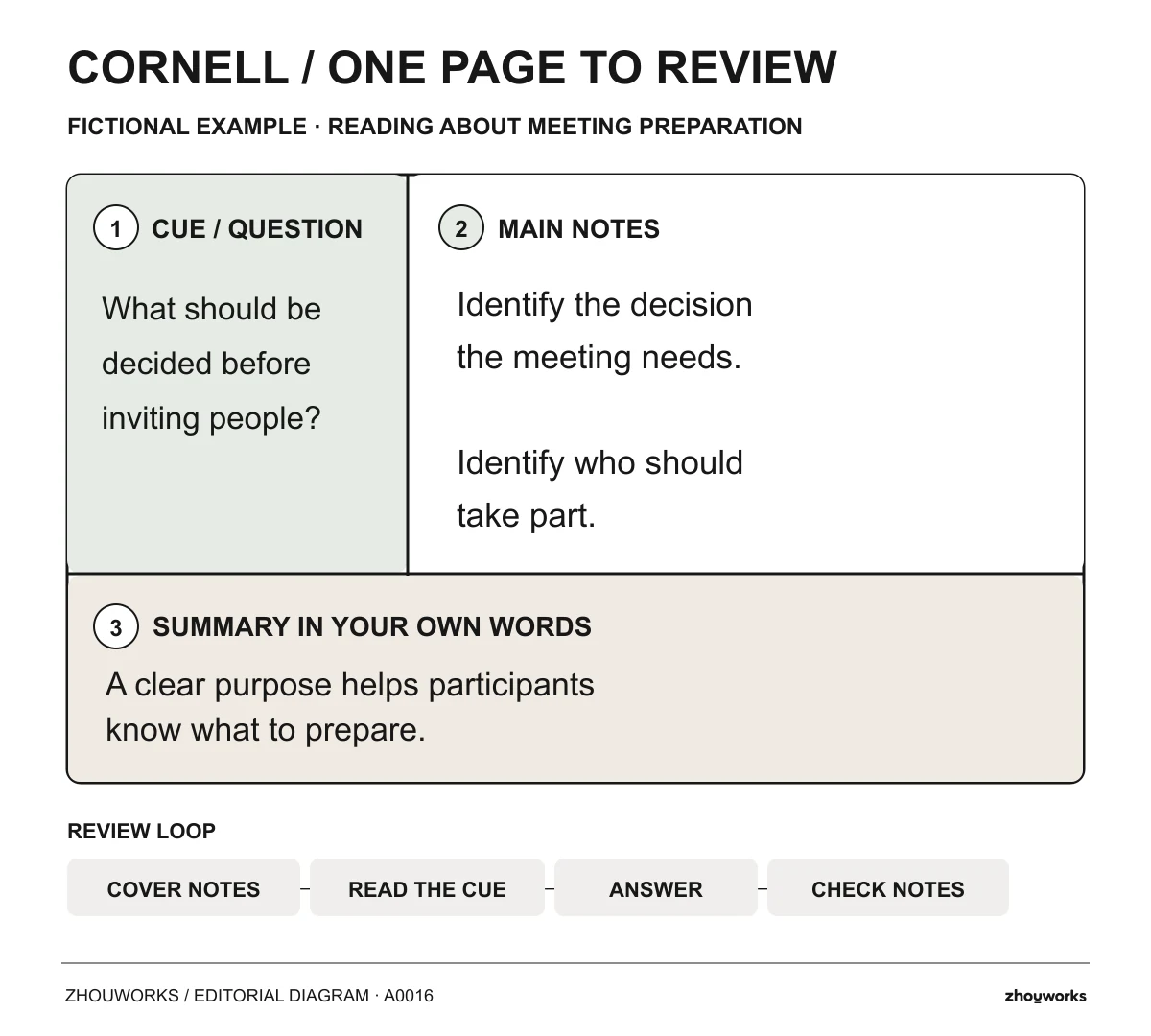
A fictional Cornell page: cues, notes and a summary each have a place to support review.
| Cue question | Notes |
|---|---|
| What should be decided before inviting people? | Identify the decision the meeting needs and who should take part. |
Summary: A clear purpose helps participants prepare. Record the book title and page so you can return to the context. Then cover the notes, look at the question and answer in your own words; reopen the page if you need it.
This page is useful when you want to revisit a chapter in order. If you are reading purely for enjoyment, you do not need a Cornell page for every chapter.
Zettelkasten: notes that can connect
A Zettelkasten is commonly described as a collection of notes that can link to one another. One approach is to write an idea clearly enough to read on its own, record its source, then link it to another relevant note and explain the connection. Zettelkasten.de's introduction emphasizes making the reason for a link explicit. People implement the approach in different ways, including paper cards and digital files.
Using the same meeting example, make a short note: “Before a meeting, write down the decision it needs to make.” Add the book, chapter and page. If you already have a note on preparing for group work, connect the two and explain: “Both help participants know what to prepare.” This is an invented illustration, not a quotation from a specific book.
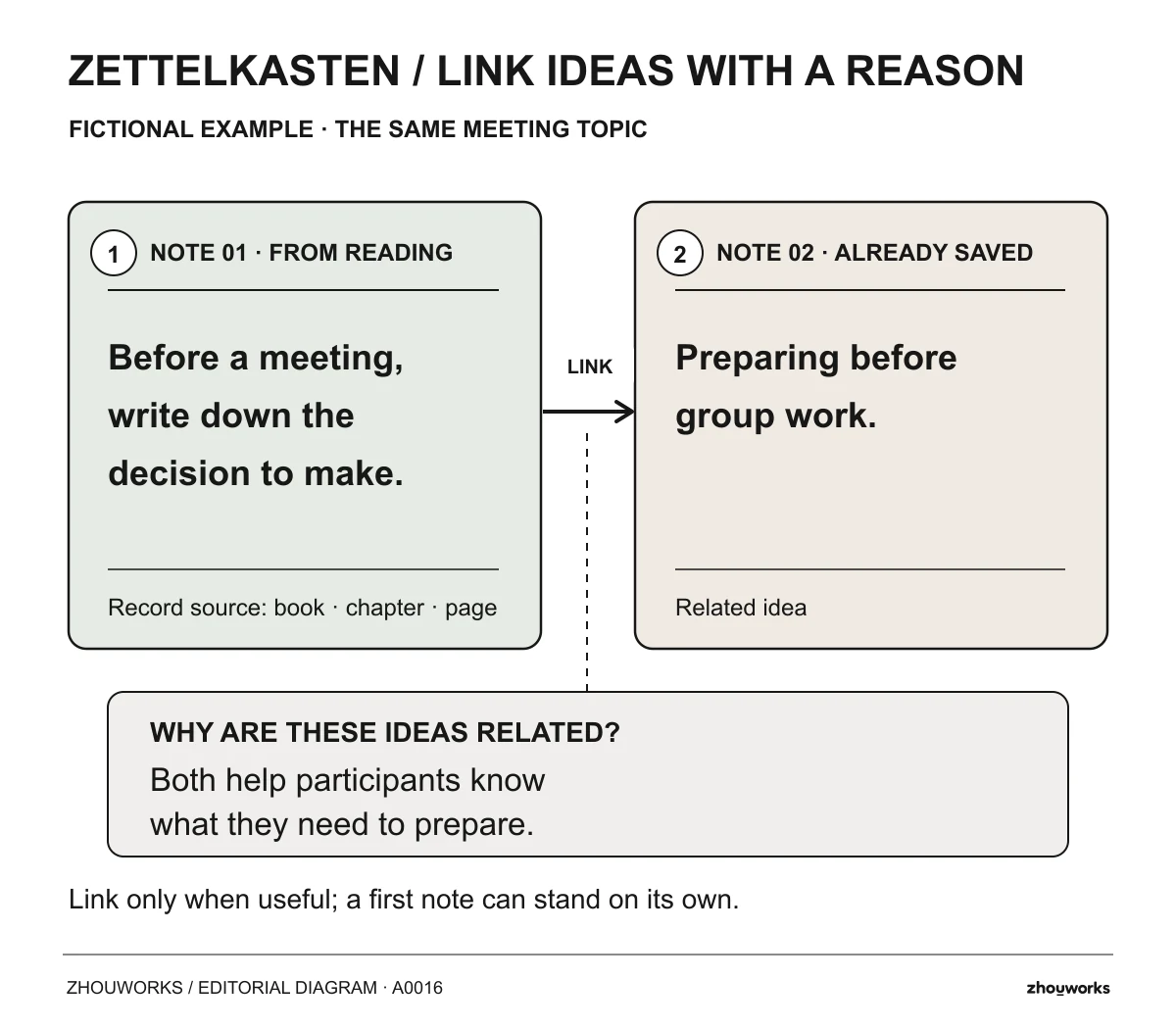
Each fictional note makes sense by itself. The link becomes useful when its reason is explicit.
On paper, write the title or identifier of the related note; in an app, you can insert a link to it. Your very first note does not need a link.
Do not add a link just to reach a target. A note can wait until a useful connection appears. This approach can help when you want to revisit, compare and develop ideas over time, but it also takes effort to organise and maintain.
Which one fits your reading?
| What you need | Try first | Why |
|---|---|---|
| Review a chapter or lesson | Cornell | Questions and a summary sit beside your notes. |
| Explore connections across books | Zettelkasten | Ideas can be kept separately and linked by meaning. |
| You are unsure what you will use | A few lines and a source | Start small and add structure when the need is clearer. |
The methods are not mutually exclusive. A Cornell page can help you understand a chapter; later, you can choose an idea worth developing and write a separate note with its source. If you only need one answer, a simple note may be enough.
Try it in your next reading session
- Choose a passage and one question you want to answer.
- Record the main idea and the source location. If you want to review the chapter, add a cue question and summary in a Cornell-style page.
- If the idea relates to another note, try a link and explain it in one sentence. If no useful connection comes to mind, leave the first note on its own.
Try both approaches with the same passage: make a short Cornell page, then write one idea as a separate note. When you revisit them, favour Cornell if you need to review the chapter, or develop the separate note if you want to connect ideas. You can keep both. You can also start with the reading-note template before choosing a larger system.